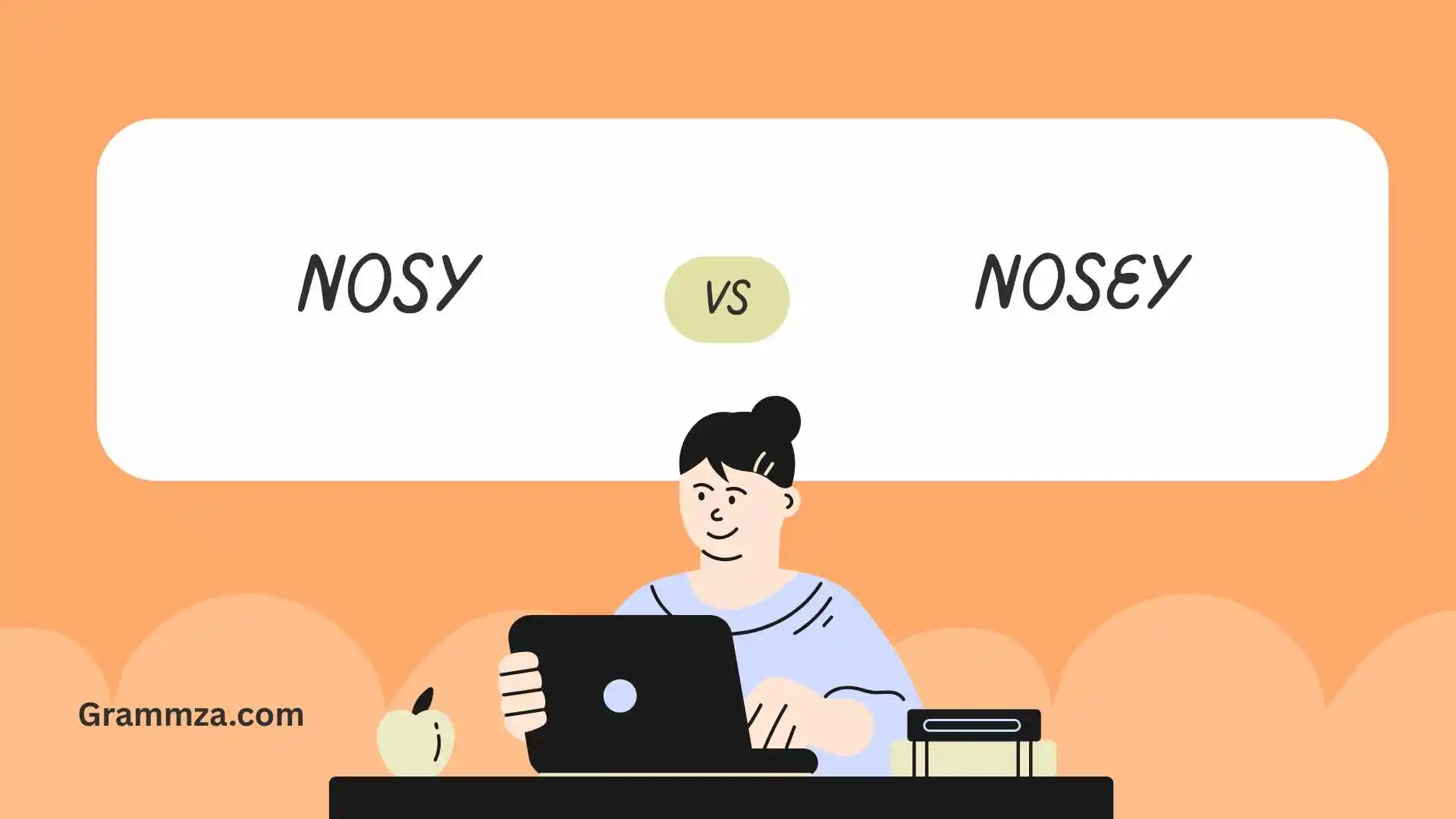
Many English learners and even native speakers get confused between “nosy” and “nosey.” Both words look very similar, and they sound exactly the same when spoken. This makes it difficult to know which spelling is correct and which one you should actually use in writing.
People often search for “nosy or nosey” because they want to avoid making mistakes in emails, essays, social media posts, or professional writing. Using the wrong spelling can sometimes make your writing look less polished or less accurate.
Understanding the difference between these two spellings is important for improving your English skills. In this article, you will learn the correct spelling, meanings, examples, common mistakes, and simple tips to remember the difference.
Quick Answer
The correct and most commonly accepted spelling is “nosy.”
“Nosey” is considered a less common or informal variant, and it is not widely preferred in standard English writing.
Meaning and Definition of Nosy or Nosey
1. Nosy
Definition:
“Nosy” means being too interested in other people’s private matters or personal business.
Simple Explanation:
A person who asks too many personal questions or tries to find out things that are not their concern is called “nosy.”
Examples:
- My neighbor is very nosy and always asks about my salary.
- Stop being so nosy and mind your own business.
- She is a nosy person who likes to know everything.
2. Nosey
Definition:
“Nosey” has the same meaning as “nosy,” but it is an alternative spelling.
Simple Explanation:
It also describes someone who is overly curious about others’ lives, but it is less commonly used.
Examples:
- He is a bit nosey about his coworkers’ personal lives.
- Don’t be nosey it’s not your problem.
Key Differences Between Nosy and Nosey
Here are the main differences between nosy or nosey:
- Spelling Preference:
- “Nosy” is the standard and widely accepted spelling.
- “Nosey” is less common and considered informal.
- “Nosy” is the standard and widely accepted spelling.
- Usage:
- “Nosy” is used in formal and informal writing.
- “Nosey” is mostly used in casual or informal contexts.
- “Nosy” is used in formal and informal writing.
- Correctness:
- “Nosy” is recommended in dictionaries and grammar guides.
- “Nosey” is sometimes accepted but not preferred.
- “Nosy” is recommended in dictionaries and grammar guides.
- Popularity:
- “Nosy” is more commonly used worldwide.
- “Nosey” is rare in professional writing.
- “Nosy” is more commonly used worldwide.
Comparison Table
| Word | Meaning | Usage | Example |
| Nosy | Too curious about others’ private matters | Standard and widely accepted | She is too nosy about my personal life. |
| Nosey | Same meaning as “nosy” | Informal and less common | He is nosey about his neighbor’s business. |
Examples in Sentences
Using “Nosy”
- My aunt is very nosy and always asks personal questions.
- Don’t be so nosy it’s rude.
- Kids can be naturally nosy about everything.
Using “Nosey”
- She is a little nosey, but she means well.
- Stop being nosey and respect people’s privacy.
- The child was nosey and looked into every room.
👉 Tip: Even though both are used, it’s better to choose “nosy” in most situations.
Common Mistakes
Here are some common mistakes people make when using nosy or nosey:
❌ Incorrect:
- She is very nosey in her office reports.
- My teacher said I am too nosey (in formal writing).
✅ Correct:
- She is very nosy in her office reports.
- My teacher said I am too nosy.
❌ Mistake:
Using “nosey” in professional or academic writing.
✅ Fix:
Always use “nosy” in formal writing.
Tips to Remember the Difference
Here are some easy tricks to remember:
1: Shorter is Better
- “Nosy” is shorter and simpler → easier to remember.
2: Think of “No + sy”
- “Nosy” = someone who doesn’t know boundaries (“No!”).
3: Formal Writing Rule
- If you’re writing something important, always use “nosy.”
When to Use Each Word
✅ Use “Nosy”:
- In essays and assignments
- In emails and professional writing
- In books and articles
- In everyday conversation
⚠️ Use “Nosey”:
- Only in informal or casual writing (optional)
- When mimicking older or regional styles
👉 Best practice: Stick with “nosy” in almost all cases.
Grammar Rules (If Applicable)
There are no complex grammar rules for nosy or nosey, but here are a few important points:
- Both words are adjectives.
- They describe a person’s behavior.
Examples:
- She is a nosy neighbor. (before noun)
- He is very nosy. (after verb)
Synonyms or Related Words
Here are some similar words you can use instead of “nosy”:
- Curious (sometimes neutral)
- Inquisitive
- Meddlesome
- Intrusive
- Prying
- Snoopy
Example:
- He is very intrusive about personal matters.
- She asked prying questions.
Frequently Asked Questions (FAQs)
1. Is “nosy” or “nosey” correct?
“Nosy” is the correct and preferred spelling. “Nosey” is less common and informal.
2. Why do people write “nosey”?
Because it sounds like “nose,” people assume it should be spelled that way. However, standard English prefers “nosy.”
3. Can I use “nosey” in formal writing?
No, it is better to use “nosy” in formal or professional writing.
4. Do both words mean the same thing?
Yes, both mean being too curious about other people’s private matters.
5. Which spelling is more common?
“Nosy” is much more common and widely accepted.
6. Is “nosy” a negative word?
Yes, it usually has a negative meaning because it describes unwanted curiosity.
Conclusion
To sum up, the confusion between nosy or nosey is very common, but the solution is simple. The correct and widely accepted spelling is “nosy.” While “nosey” exists, it is less common and not recommended for formal writing.
If you want to write clearly and correctly, always choose “nosy.” Remember that it describes someone who is too interested in other people’s personal matters often in a negative way.
By following the tips and examples in this guide, you can confidently use the correct spelling every time. Keep practicing, and soon this confusion will be a thing of the past!

I am Daniel Harper, a passionate grammar writer dedicated to making English simple and easy to understand. I focus on breaking down confusing rules into clear, practical lessons. I enjoy helping readers improve their writing skills with confidence and clarity. My goal is to make grammar learning smooth, engaging, and useful for everyone.