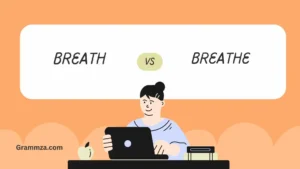
Many English learners and even native speakers often get confused between “breath” and “breathe.” These two words look very similar, sound almost the same, and are closely related in meaning. Because of this, people often use one when they actually mean the other.
This confusion is one of the most common grammar mistakes, which is why so many people search online for “breath or breathe.” Whether you are writing an email, a school essay, or a social media post, using the wrong word can make your sentence incorrect or unclear.
Understanding the difference between these two words is important for clear communication. In this article, you will learn the exact meanings, key differences, examples, grammar rules, and simple tips to help you always choose the correct word.
Quick Answer
“Breath” is a noun. It refers to the air you take in or let out of your lungs.
“Breathe” is a verb. It describes the action of taking air in and out of your body.
👉 Simple rule:
- If it’s a thing, use breath
- If it’s an action, use breathe
Meaning and Definition of Breath or Breathe
What Does “Breath” Mean?
Breath (noun) is the air that goes into and comes out of your lungs.
Simple definition:
It is the air you inhale or exhale.
Examples:
- Take a deep breath before you start speaking.
- His breath smelled like mint.
- She held her breath during the scary scene.
What Does “Breathe” Mean?
Breathe (verb) means to take air into your lungs and let it out.
Simple definition:
It is the action of inhaling and exhaling air.
Examples:
- Remember to breathe slowly during meditation.
- He couldn’t breathe properly after running.
- Plants breathe differently than humans.
Key Differences Between Breath or Breathe
Here are the main differences between breath and breathe:
- Part of speech:
- Breath → Noun
- Breathe → Verb
- Breath → Noun
- Function:
- Breath → A thing (air)
- Breathe → An action (taking air in and out)
- Breath → A thing (air)
- Usage in sentences:
- Breath → Used as an object
- Breathe → Used as an action
- Breath → Used as an object
- Spelling difference:
- Breath → Ends with “-th”
- Breathe → Ends with “-the”
- Breath → Ends with “-th”
- Pronunciation:
- Breath → Short sound (/breth/)
- Breathe → Longer sound (/breathe/)
- Breath → Short sound (/breth/)
Comparison Table
| Word | Meaning | Usage | Example |
| Breath | Air from lungs | Noun | Take a deep breath before speaking. |
| Breathe | To inhale and exhale air | Verb | Try to breathe slowly and relax. |
Examples in Sentences
“Breath”
- She took a deep breath before jumping into the water.
- His breath was visible in the cold air.
- I need a moment to catch my breath.
- The doctor checked his breath.
- Her breath was calm and steady.
“Breathe”
- It’s hard to breathe in polluted air.
- Please breathe deeply and relax.
- He stopped to breathe after climbing the stairs.
- Try to breathe through your nose.
- She couldn’t breathe because of the smoke.
Common Mistakes
Many people mix up these words because they look similar. Let’s look at common mistakes:
Incorrect vs Correct Usage
I can’t breath properly.
I can’t breathe properly.
Take a deep breathe.
Take a deep breath.
He forgot to breath slowly.
He forgot to breathe slowly.
She held her breathe.
She held her breath.
Tips to Remember the Difference
Here are some simple tricks to help you remember:
1. The “E” Trick
- Breathe has an extra “E”
- That extra “E” stands for Effort (action) → verb
2. Think: Action vs Thing
- If it’s something you do → breathe
- If it’s something you have → breath
3. Sentence Test
Try replacing the word with:
- “Action” → use breathe
- “Air” → use breath
When to Use Each Word
Use “Breath” When:
- You are talking about air
- You are describing a physical state
- You are using phrases like:
- Take a breath
- Catch your breath
- Out of breath
- Take a breath
Examples:
- I need to catch my breath.
- She took a deep breath.
Use “Breathe” When:
- You are describing an action
- You are giving instructions
- You are talking about living processes
Examples:
- Don’t forget to breathe.
- It’s hard to breathe in this room.
Grammar Rules (Important)
Understanding grammar helps you use these words correctly.
1. “Breath” is Always a Noun
It cannot be used as an action word.
✔ Correct: Take a deep breath
❌ Incorrect: I breath slowly
2. “Breathe” is Always a Verb
It shows an action.
✔ Correct: I breathe slowly
❌ Incorrect: I breathe a deep
3. Verb Forms of “Breathe”
- Base form: breathe
- Past tense: breathed
- Present continuous: breathing
Examples:
- She breathed deeply.
- He is breathing fast.
Synonyms or Related Words
“Breath”
- Air
- Inhale
- Exhale
- Puff
“Breathe”
- Inhale
- Exhale
- Respire
Frequently Asked Questions (FAQs)
1. What is the difference between breath or breathe?
Breath is a noun (air), while breathe is a verb (action of taking air in and out).
2. How do I remember breath vs breathe?
Remember: breathe has an extra “E” for action (effort), so it is a verb.
3. Is it “take a breath” or “take a breathe”?
The correct phrase is “take a breath.”
4. Is “I can’t breath” correct?
No, the correct sentence is:
✅ “I can’t breathe.”
5. What is the past tense of breathe?
The past tense is “breathed.”
6. Can breath be used as a verb?
No, breath is only a noun and cannot be used as a verb.
Conclusion
The confusion between “breath or breathe” is very common, but the difference is actually simple once you understand it. Breath is a noun that refers to air, while breathe is a verb that describes the action of taking air in and out.
By remembering a few simple rules like the extra “E” in breathe for action you can easily avoid mistakes. Practice using both words in sentences, and soon it will feel natural.
Clear grammar makes your communication stronger, so mastering small differences like this can make a big improvement in your English.

I am Daniel Harper, a passionate grammar writer dedicated to making English simple and easy to understand. I focus on breaking down confusing rules into clear, practical lessons. I enjoy helping readers improve their writing skills with confidence and clarity. My goal is to make grammar learning smooth, engaging, and useful for everyone.