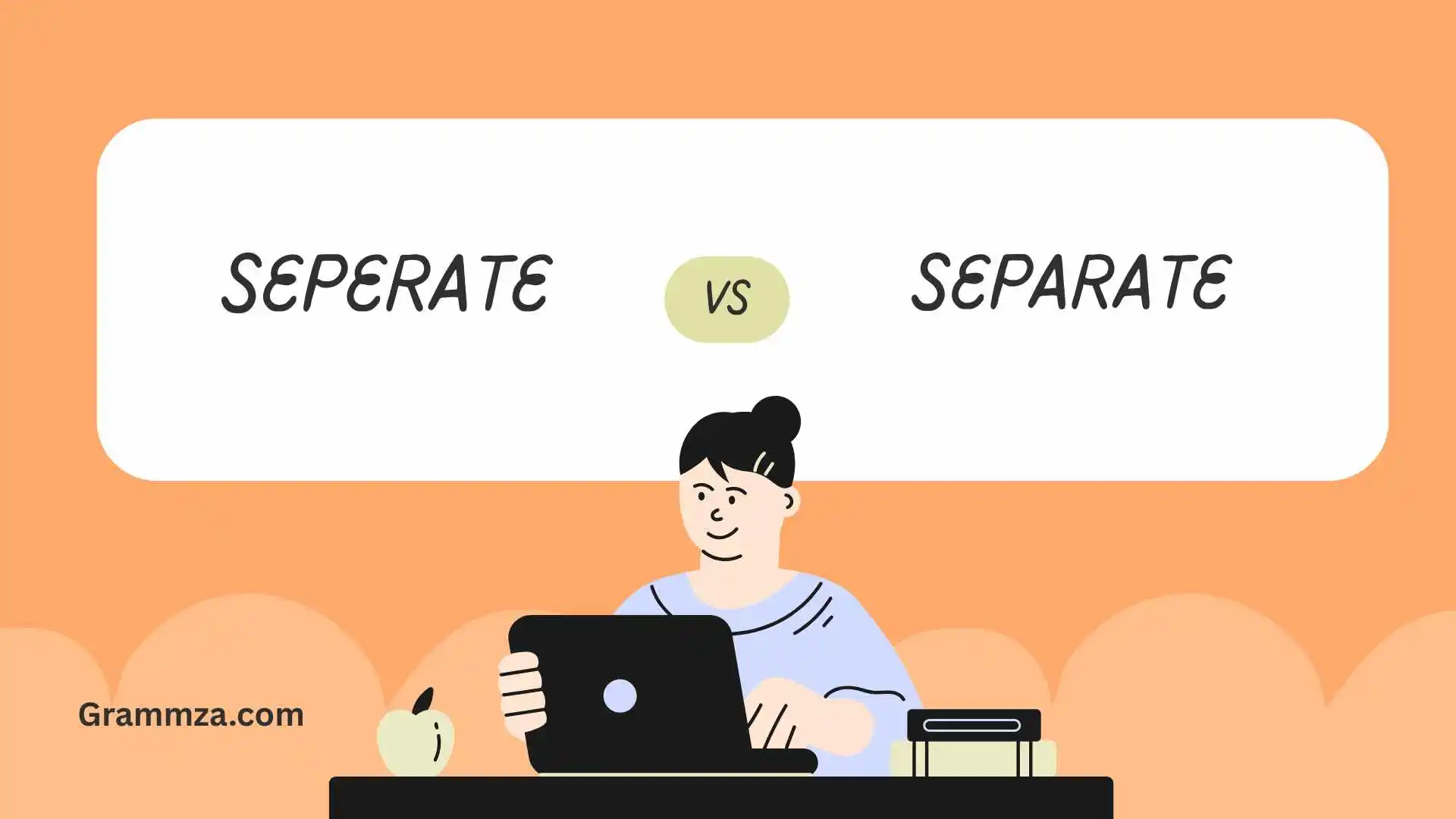
Many English learners and even native speakers often get confused between “seperate or separate.” At first glance, both words may look correct, but only one of them is actually accepted in standard English. This confusion happens because English spelling can be tricky, and some words don’t sound exactly like they are written.
People search for “seperate or separate” because they want to avoid spelling mistakes, especially in writing emails, essays, or professional documents. A small spelling error can sometimes make a big difference in how your writing is perceived.
Understanding the correct spelling is important for clear communication. In this article, you will learn the correct usage, meanings, examples, common mistakes, and easy tips to remember the difference between these two words.
Quick Answer
The correct spelling is “separate.”
“Seperate” is incorrect and should not be used in standard English writing.
Always use “separate” when you want to describe things that are divided, distinct, or not together.
Meaning and Definition of Each Word
1. Separate (Correct Word)
Definition:
“Separate” means to divide, keep apart, or make something distinct from something else.
Simple Explanation:
It is used when things are not together or when you want to divide them.
Examples:
- Please separate the white clothes from the colored ones.
- They decided to live in separate houses.
- The teacher asked us to write our answers on separate sheets.
2. Seperate (Incorrect Word)
Definition:
“Seperate” is a misspelling of “separate.”
Simple Explanation:
It looks similar to “separate,” but it is not a correct English word.
Examples:
- ❌ Incorrect: Please seperate the files.
- ✅ Correct: Please separate the files.
Key Differences Between the Words
Here are the main differences between seperate or separate:
- ✅ “Separate” is correct and widely accepted in English.
- ❌ “Seperate” is incorrect and considered a spelling mistake.
- “Separate” can be used as both a verb and an adjective.
- “Seperate” has no meaning in standard English.
- Using “seperate” may make your writing look unprofessional.
Comparison Table
| Word | Meaning | Usage | Example Sentence |
| Separate | To divide or keep things apart | Correct | Please separate the papers. |
| Seperate | Incorrect spelling of “separate” | Incorrect / Not used | ❌ Please seperate the papers. |
Examples in Sentences
Using “Separate” Correctly
- We need to separate fact from opinion.
- The twins study in separate classrooms.
- Oil and water do not mix; they stay separate.
- Please keep these items in separate boxes.
- The company has separate departments for sales and marketing.
Incorrect Usage of “Seperate”
- ❌ I will seperate the documents.
- ❌ They live in seperate apartments.
- ❌ Please seperate these two items.
👉 Always replace “seperate” with “separate.”
Common Mistakes
Here are some common mistakes people make with seperate or separate:
❌ Incorrect vs ✅ Correct
- ❌ Seperate the two groups.
✅ Separate the two groups. - ❌ They have seperate rooms.
✅ They have separate rooms. - ❌ Keep these things seperate.
✅ Keep these things separate.
Why This Happens
- The pronunciation can confuse learners.
- People often forget the “a” in the middle of “separate.”
- It is easy to mix up vowel sounds in English spelling.
Tips to Remember the Difference
Here are some simple tricks to remember the correct spelling:
1. Use the “A RAT” Trick 🐀
Think of the word sep-A-RAT-e
👉 There is a small word “a rat” inside “separate.”
separate = sep + A + RAT + e
This trick helps you remember the correct spelling easily.
2. Break It into Parts
Separate → sep + ar + ate
Focus on the “ar” in the middle.
3. Practice Writing
Write the word “separate” a few times daily:
- separate
- separate
- separate
Repetition helps you remember.
4. Use Spell Check
Always double-check your writing using tools like spell check.
When to Use Each Word
Use “Separate” When:
- You want to divide something:
- Separate the sugar from the flour.
- Separate the sugar from the flour.
- You want to show distinction:
- They have separate opinions.
- They have separate opinions.
- You describe things that are not together:
- We sat at separate tables.
- We sat at separate tables.
Do NOT Use “Seperate”
- It is never correct in formal or informal writing.
- Always replace it with “separate.”
Grammar Rules (If Applicable)
“Separate” can be used in different ways:
1. As a Verb
Meaning: To divide or split
Examples:
- Please separate the pages.
- The teacher separated the students into groups.
2. As an Adjective
Meaning: Distinct or not together
Examples:
- They live in separate houses.
- We need separate accounts.
3. As a Noun (Rare Use)
Sometimes used in specific contexts, like clothing:
- The store sells jacket and pant separates.
Synonyms or Related Words
Here are some similar words to “separate”:
- Divide
- Split
- Isolate
- Disconnect
- Distinguish
- Apart
Example:
- Please divide the items. (Similar to separate)
Frequently Asked Questions (FAQs)
1. Is “seperate” ever correct?
No, “seperate” is always incorrect. The correct spelling is “separate.”
2. Why do people spell “separate” as “seperate”?
Because of pronunciation confusion and difficulty remembering the correct vowel placement.
3. How can I remember the spelling of “separate”?
Use the “A RAT” trick: sep + A + RAT + e.
4. Is “separate” a verb or an adjective?
It can be both:
- Verb: Please separate the items.
- Adjective: They are in separate rooms.
5. Is “separate” commonly misspelled?
Yes, it is one of the most commonly misspelled English words.
6. Can I use “separate” in formal writing?
Yes, “separate” is correct and commonly used in both formal and informal writing.
Conclusion
When it comes to “seperate or separate,” the answer is simple:
✅ “Separate” is correct
❌ “Seperate” is wrong
This is a common spelling mistake, but with a few easy tricks like the “A RAT” method, you can remember the correct form easily. Always double-check your writing and practice using the correct spelling in sentences.
By mastering this small but important difference, you can improve your English writing and avoid common errors.

I am Daniel Brooks, a passionate grammar enthusiast who loves making English easy and clear for everyone. I focus on simplifying tricky grammar rules so readers can understand them without confusion. I enjoy creating helpful and engaging content that improves everyday writing skills. My goal is to make learning grammar simple, practical, and enjoyable for all.