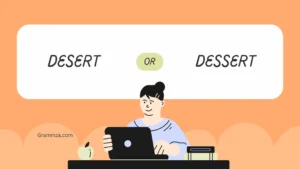
Many English learners and even native speakers often get confused between the words desert and dessert. At first glance, they look very similar only one extra “s” makes the difference. But in reality, these two words have completely different meanings.
Understanding the difference between these words is important for clear communication. Imagine telling someone you want to eat a “desert” instead of a “dessert” that could lead to a very strange situation! These kinds of mistakes are common, but they are easy to fix once you know the rules.
In this article, you will learn everything you need to know about desert or dessert. We will break down their meanings, show examples, explain key differences, and give you simple tips to remember which word to use. By the end, you will feel confident using both words correctly.
Quick Answer
“Desert” usually refers to a dry, sandy place with very little water, or it can mean to abandon something.
“Dessert” refers to sweet food eaten at the end of a meal.
👉 A simple trick: Dessert has two “s” because you want more of it!
Meaning and Definition of Each Word
What is “Desert”?
The word desert has more than one meaning, depending on how it is used.
1. Desert (noun) – A dry place
A desert is a large, dry area of land with little or no rainfall.
Examples:
- The Sahara is the largest hot desert in the world.
- Camels can survive in the desert for many days without water.
2. Desert (verb) – To abandon
As a verb, desert means to leave someone or something behind, usually in a negative way.
Examples:
- He deserted his friends when they needed him most.
- The soldier was punished for deserting his post.
What is “Dessert”?
The word dessert is much simpler.
Dessert (noun) – Sweet food
A dessert is a sweet dish eaten at the end of a meal.
Examples:
- We had chocolate cake for dessert.
- Ice cream is my favorite dessert.
Key Differences Between Desert and Dessert
Here are the main differences between these two words:
- Meaning:
- Desert = a dry place OR to abandon
- Dessert = sweet food after a meal
- Spelling:
- Desert = one “s”
- Dessert = two “s”
- Usage:
- Desert is used in geography or actions
- Dessert is used in food-related contexts
- Pronunciation:
- Desert (noun) → DEZ-ert
- Dessert → dih-ZERT
- Part of speech:
- Desert can be a noun or verb
- Dessert is always a noun
Comparison Table
| Word | Meaning | Usage | Example |
| Desert | Dry land or to abandon | Geography or actions | The desert is very hot during the day. |
| Dessert | Sweet food after a meal | Food-related context | She ordered cake for dessert. |
Examples in Sentences
Desert (Dry Land)
- The desert becomes very cold at night.
- Many animals have adapted to live in the desert.
- We traveled across the desert for two days.
Desert (To Abandon)
- He deserted his responsibilities.
- They felt hurt when their leader deserted them.
- Never desert your goals, even in hard times.
Dessert (Sweet Dish)
- I always save room for dessert.
- Fruit salad is a healthy dessert.
- We enjoyed a delicious dessert after dinner.
Common Mistakes
Many people confuse these words because of their similar spelling. Let’s look at some common mistakes:
Incorrect vs Correct Usage
I ate a delicious desert after dinner.
I ate a delicious dessert after dinner.
The camel lives in the dessert.
The camel lives in the desert.
He desserted his team.
He deserted his team.
👉 Always check the number of “s” letters to avoid mistakes!
Tips to Remember the Difference
Here are some simple tricks to help you remember:
1. The “Extra S” Trick
- Dessert = 2 S → Sweet Stuff
- You want more dessert, so it has more “s”!
2. Think of Food
- If it’s something you eat after a meal → it’s dessert
3. Think of Sand
- If it’s a dry place with sand → it’s desert
4. Memory Sentence
- “I want dessert (two S) after walking in the desert (one S).”
When to Use Each Word
Use “Desert” when:
- Talking about dry, sandy areas
- Describing climate or geography
- Talking about leaving or abandoning someone
Examples:
- The desert has very little rainfall.
- He deserted his duties.
Use “Dessert” when:
- Talking about food
- Referring to sweets after meals
Examples:
- We had pudding for dessert.
- Dessert is the best part of dinner!
Grammar Rules (If Applicable)
Desert as a Noun and Verb
- As a noun, it refers to a place
- As a verb, it means to abandon
Example:
- Noun: The desert is hot.
- Verb: He deserted his team.
Dessert as a Noun Only
- “Dessert” is always a noun
- It cannot be used as a verb
Example:
- Correct: She ate dessert.
- Incorrect: She desserted the cake.
Synonyms or Related Words
Desert (Dry Area)
- Wasteland
- Dunes
- Arid land
Desert (To Abandon)
- Leave
- Forsake
- Abandon
Dessert
- Sweet dish
- Treat
- Pudding
- Confection
Frequently Asked Questions (FAQs)
1. What is the difference between desert and dessert?
Desert is a dry place or means to abandon, while dessert is a sweet food eaten after a meal.
2. Why does dessert have two “s”?
Dessert has two “s” as a memory trick you want more sweets, so it has more “s”.
3. Can desert be used as a verb?
Yes, desert can mean to abandon someone or something.
4. Is dessert ever used as a verb?
No, dessert is always a noun.
5. How do you remember desert vs dessert easily?
Remember: dessert = sweet = two “s”. Desert = sand = one “s”.
6. Which one is correct: “ice cream desert” or “ice cream dessert”?
The correct phrase is ice cream dessert.
Conclusion
Understanding the difference between desert or dessert is simple once you know their meanings and spelling. A desert is a dry place or means to abandon, while a dessert is a sweet treat you enjoy after a meal. The extra “s” in dessert is your best clue it stands for something sweet and special.
By practicing the examples and using the memory tricks shared in this article, you can easily avoid confusion. Keep these differences in mind, and you’ll never mix up these words again!