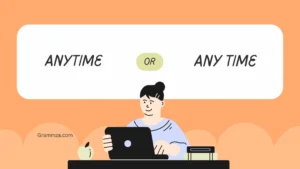
Many English learners and even native speakers often get confused between “anytime” or “any time.” At first glance, these two look almost identical, and in casual writing, people sometimes use them interchangeably. However, there is an important grammatical difference between them that can change how correct your sentence sounds.
The confusion usually happens because both forms relate to time and flexibility. When someone says, “Call me anytime,” it sounds perfectly natural. But if you say, “Call me any time,” is it still correct? The answer is yes but only in certain situations. That’s why many people search for “anytime or any time” to understand which one to use and when.
Understanding the difference between these two forms is important if you want to improve your grammar, writing clarity, and overall communication skills. In this detailed guide, you will learn the meaning, usage, rules, examples, and tips to confidently use anytime and any time correctly.
Quick Answer
“Anytime” is an adverb and means whenever or at any moment.
“Any time” is a noun phrase and refers to an amount of time.
👉 Quick rule:
- Use anytime when you don’t need a preposition.
- Use any time when it comes after words like at, in, or for.
Meaning and Definition of Each Word
What Does “Anytime” Mean?
Anytime is an adverb. It means whenever, at any moment, or no matter when.
It is often used informally and is very common in spoken English.
Examples:
- You can call me anytime.
- Visit us anytime you like.
- I’m available anytime this week.
👉 In these sentences, “anytime” replaces phrases like “at any time.”
What Does “Any Time” Mean?
Any time is a noun phrase. It refers to an amount of time or a period of time.
It is often used after prepositions like:
- at
- in
- for
Examples:
- Do you have any time to talk?
- I don’t have any time today.
- She didn’t spend any time on the task.
👉 Here, “any time” works like a measurable thing (time as a quantity).
Key Differences Between Anytime or Any Time
Here are the main differences in a simple and clear format:
- Part of Speech:
- Anytime = Adverb
- Any time = Noun phrase
- Usage:
- Anytime = Used to mean whenever
- Any time = Refers to an amount of time
- Prepositions:
- Anytime = Does NOT follow prepositions
- Any time = Often follows prepositions (at, in, for)
- Formality:
- Anytime = More informal
- Any time = More formal and traditional
- Example:
- Anytime: Come anytime.
- Any time: Come at any time.
Comparison Table
| Word | Meaning | Usage | Example |
| Anytime | Whenever / at any moment | Adverb (no preposition needed) | Call me anytime. |
| Any time | Amount of time | Noun phrase (used with prepositions) | I don’t have any time. |
Examples in Sentences
“Anytime”
- You can visit us anytime.
- I’m free anytime after lunch.
- Feel free to message me anytime.
- She can start the job anytime.
- We are open anytime during the week.
“Any Time”
- I don’t have any time to relax.
- Do you have any time for a meeting?
- He didn’t spend any time preparing.
- She won’t have any time tomorrow.
- They didn’t give me any time to explain.
Common Mistakes
Many learners make simple mistakes when using anytime or any time. Let’s fix them.
❌ Incorrect vs ✅ Correct
Call me at anytime.
Call me at any time.
Do you have anytime to help me?
Do you have any time to help me?
You can come at anytime.
You can come anytime OR at any time
Why These Mistakes Happen
- People confuse adverbs and noun phrases
- Informal English blurs the difference
- Lack of awareness about grammar rules
Tips to Remember the Difference
Here are some easy tricks to help you remember:
1. Check for Prepositions
If you see words like at, in, for, use any time.
👉 Example:
- at any time ✔
- at anytime ❌
2. Replace with “Whenever”
If you can replace the word with “whenever”, use anytime.
👉 Example:
- Call me anytime → Call me whenever ✔
3. Think About Quantity
If you’re talking about how much time, use any time.
👉 Example:
- I don’t have any time ✔
4. Simple Memory Trick
👉 Anytime = One word = Quick action (whenever)
👉 Any time = Two words = Measurable time
When to Use Each Word
Use “Anytime” When:
- You mean whenever
- No preposition is used
- The sentence is informal
Examples:
- Come anytime.
- You can call anytime.
- I’m ready anytime.
Use “Any Time” When:
- Talking about amount of time
- After prepositions
- In formal writing
Examples:
- I don’t have any time.
- At any time, you may leave.
- She didn’t spend any time studying.
Grammar Rules
Here are the key grammar rules for anytime or any time:
1: Adverb vs Noun Phrase
- Anytime = Adverb
- Any time = Noun phrase
2: Prepositions Matter
- Use any time after:
- at
- in
- for
3: Informal vs Formal
- Anytime is common in casual English
- Any time is preferred in formal writing
4: Flexibility in Modern English
In modern usage, especially in American English, “anytime” is becoming more widely accepted even in places where “any time” was traditionally used.
Synonyms or Related Words
Here are some alternatives depending on context:
For “Anytime”
- Whenever
- At any moment
- No matter when
For “Any Time”
- Some time
- Time period
- Free time
Frequently Asked Questions (FAQs)
1. Is “anytime” one word or two words?
Both are correct, but they have different meanings.
- “Anytime” = adverb
- “Any time” = noun phrase
2. Can I use “anytime” in formal writing?
It’s better to use “any time” in formal writing, especially after prepositions.
3. Is “at anytime” correct?
❌ No
✅ Correct form: at any time
4. Can “anytime” replace “any time”?
Not always. It depends on the sentence structure and grammar.
5. Which is more common in everyday English?
“Anytime” is more common in casual conversations.
6. How do I quickly decide which one to use?
- If you can replace it with whenever → use anytime
- If it follows a preposition → use any time
Conclusion
Understanding the difference between anytime or any time is simple once you know the basic rule. Anytime is an adverb that means whenever, while any time is a noun phrase that refers to an amount of time. The key difference lies in grammar and sentence structure.
If you remember just one thing, let it be this:
👉 Use anytime for flexibility (whenever)
👉 Use any time for quantity (time amount)
With practice and attention, you’ll quickly start using both forms correctly in your writing and speech. Keep these tips in mind, and you’ll never be confused again!
READ MORE LIKE THIS..
Cancelled or Canceled: Which Spelling Is Right for You in 2026
True or False: Meaning, Differences, Usage, and Easy Guide 2026
Cancelled or Canceled: Which Spelling Is Right for You in 2026
Greater Than or Equal To: Complete Guide for 2026
Grey or Gray: What’s the Difference and Which One Should You Use?